Zwave vs Zigbee vs Matter vs WiFi: Best Smart Home Protocol in 2026

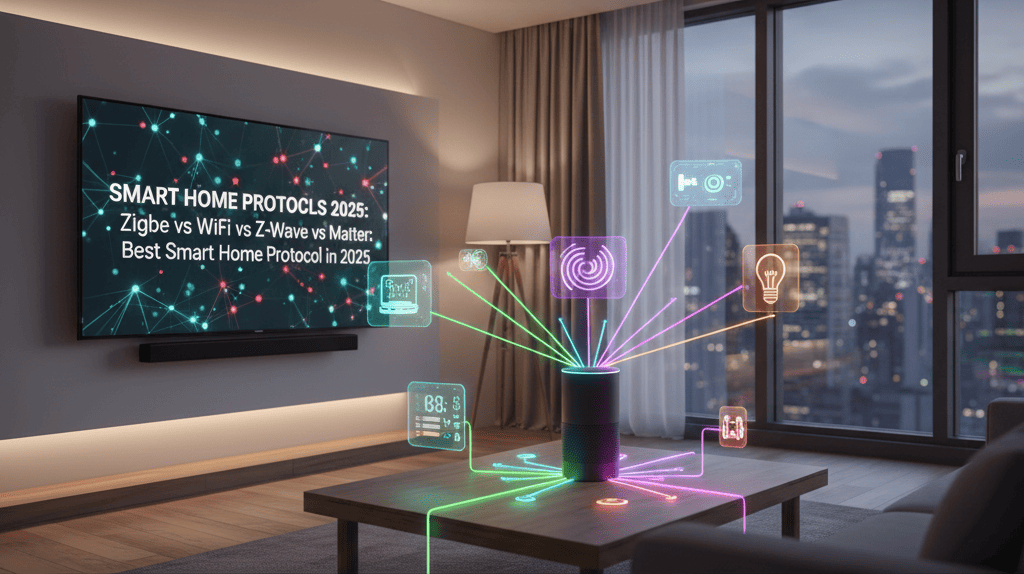
Trying to build a reliable smart home often leads to frustrating compatibility issues because devices speak different “languages”. In 2025, choosing the right communication protocol is crucial for ensuring speed, privacy, and future-proof Home Automation. This guide cuts through the confusion, comparing Zigbee, Z-Wave, Matter, and WiFi to help you select the ideal network backbone.
The Core Contenders: ZWave vs Zigbee in 2026
When debating the fundamental communication standards, the choice between ZWave vs Zigbee defines the mesh foundation for many battery-powered sensors and controllers. Both are established, low-power mesh networks, but they excel in different areas.
Zigbee: The Cost-Effective Workhorse
Zigbee is a trusted, established protocol known for its low power usage, making it ideal for battery-operated sensors and switches. It utilizes a mesh network where each mains-powered device acts as a repeater, strengthening the network as you add more devices. The system is capable of supporting a massive number of devices, theoretically up to 65,000 nodes on a single network, which is beneficial for households planning extensive smart home setups.
Zigbee operates on the widely used 2.4 GHz frequency band. This maturity means Zigbee devices are often the most affordable at scale, allowing for cost-effective expansion. However, operating in the 2.4 GHz band means it is susceptible to potential interference with Wi-Fi, Bluetooth, and other common household electronics. While setup is generally straightforward, Zigbee devices require a dedicated hub or coordinator, such as the Aqara Hub M3 or Aqara Camera Hub G3, to connect to your smartphone and voice assistants.
ZWave: The Secure, Low-Interference Option
Z-Wave is another mesh network protocol renowned for its stability and secure communication. Z-Wave operates on a unique sub-GHz radio frequency (e.g., 908.42 MHz in the US). This lower frequency gives Z-Wave a major advantage: it is less likely to clash with 2.4 GHz Wi-Fi and offers superior penetration through walls compared to 2.4 GHz peers.
Z-Wave’s stability and AES-128 encryption security framework make it frequently used in home security setups, particularly for smart locks and door sensors. It supports a maximum of 232 devices on a single network, which is sufficient for most larger smart homes. If you prioritize high reliability in an environment where 2.4 GHz interference is a concern, Z-Wave is a solid choice. However, the certification costs associated with its proprietary technology often mean that Z-Wave devices are pricier and the ecosystem is smaller compared to Zigbee's.
The Game Changers: Matter and Wi-Fi
Beyond Zigbee and Z-Wave, two other protocols are shaping the 2026 smart home landscape: the familiar high-speed WiFi and the revolutionary new standard, Matter.
Matter: The Universal Language of Tomorrow
Matter is not a new wireless protocol, but an open-source application-layer connectivity standard designed to unify how devices communicate and interoperate. Backed by giants like Apple, Google, Amazon, and Samsung, Matter aims to end compatibility headaches by ensuring that devices from different manufacturers can work seamlessly across major platforms like Apple Home and Alexa.
Matter works over existing transport mechanisms, including Wi-Fi, Ethernet, and Thread (a low-power mesh protocol). Its core benefits include local-first control (meaning automations run even if the internet drops), enhanced end-to-end encryption security, and simplified multi-admin setup via QR codes. While still maturing and facing some limited device availability, Matter is the recommended choice for future-proofing your smart home ecosystem.
Wi-Fi: Simple, Fast but Power-Hungry
Wi-Fi is the most widely adopted protocol in homes, offering high bandwidth and fast transmission speeds, up to 1 Gbps. Its simplicity means no separate hub is needed for basic functionality, as devices connect directly to your existing router. This makes Wi-Fi the best choice for high-bandwidth devices like security cameras, smart TVs, and video doorbells.
However, the convenience of Wi-Fi comes with several trade-offs. Wi-Fi radios draw more power, making this protocol power-hungry and unsuitable for battery-operated sensors that need multi-year battery life. Furthermore, standard home routers often limit the number of simultaneous connections (sometimes as few as 30), and adding too many smart devices can lead to network congestion and slow response times. For security, remote control often requires sending data to a manufacturer's cloud server, which can introduce latency and privacy concerns.
People Also Asked:
Technical Comparison: ZWave vs Zigbee vs Matter vs WiFi
| Protocol | Power Profile | Range & Topology | Interoperability (2026) | Best Use Case |
|---|---|---|---|---|
| Zigbee | Low (Excellent for battery) | Mesh network (2.4 GHz) | Medium (Requires Hub/Bridge) | Cost-effective lighting and low-data sensors at scale |
| Z-Wave | Very Low | Mesh network (Sub-GHz) | Medium (Requires Hub/Bridge) | High-reliability locks, security, and homes with thick walls |
| Matter | Varies (Low over Thread; High over Wi-Fi) | Depends on transport (Mesh over Thread, Star over Wi-Fi) | High (Cross-ecosystem standard) | Future-proofing, multi-ecosystem control, unified experience |
| Wi-Fi | Moderate to High | Star (Connects to APs) | Vendor-Dependent | High-bandwidth devices (Cameras, video doorbells) |
The 2026 Smart Home Strategy: Building a Hybrid Network
The complexity of modern automation means that the most reliable and advanced homes in 2025 will run a hybrid network, combining the strengths of the various protocols Zigbee, Matter, WiFi, ZWave.
- Bridging Legacy Devices: If you already own devices, especially reliable Zigbee sensors or bulbs, you do not need to replace them. Modern multi-protocol hubs, such as the Aqara M3 Hub, support Zigbee 3.0, Thread, and Matter, acting as a Matter bridge to expose your existing Zigbee devices to the new Matter ecosystem. This preserves your investment while granting cross-platform benefits.
- Matching Protocol to Job: Design your network by function:
- Use Matter over Thread for battery-powered devices like motion sensors and door locks, leveraging the low power profile and self-healing mesh.
- Continue to use Zigbee for large-scale, cost-effective lighting installations.
- Employ Z-Wave for critical security components or in areas with thick walls where 2.4 GHz signals struggle.
- Reserve Wi-Fi for high-bandwidth, mains-powered devices like surveillance cameras and streaming devices.
- Prioritizing Local Control: Favor devices and platforms designed for local automations, which ensure faster response times and continued functionality even during internet outages. Matter is local-first by design, which enhances reliability.
Final Verdict: Which Protocol is the Best?
There is no single best smart home protocol in 2026. The right choice depends on your goals. When comparing zwave vs zigbee, Zigbee remains a cost-effective and mature option for large lighting and sensor deployments, while Z-Wave delivers more reliable performance for security devices and homes with thick walls using sub-GHz frequencies. For seamless interoperability across Apple Home, Google Home, and Amazon Alexa, Matter devices, ideally over Thread for battery-powered devices, are the most future-ready choice. Ultimately, using certified devices and a controlled hybrid network ensures a stable and future-proof smart home.