What is ZigBee and What it Does for Smart Home

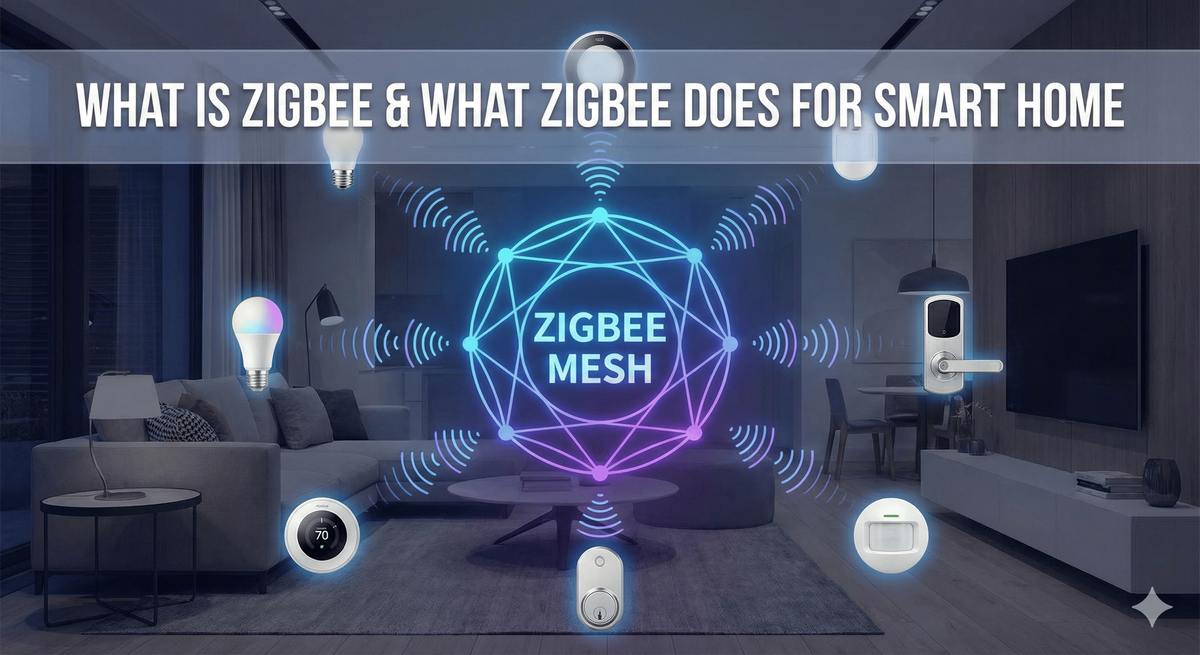
Zigbee is a low-power, low-rate wireless communication protocol that serves as the essential backbone for modern smart homes. Built upon the IEEE 802.15.4 standard, it is an open, global, packet-based protocol designed for secure, reliable, low power wireless networks. This technology creates a robust, self-healing mesh network where Zigbee devices communicate with each other to extend coverage. This highly efficient system enables battery-operated sensors and switches to function for years while securely connecting thousands of points.
What is Zigbee? The Foundation of the Connected Home
Zigbee is a wireless technology developed for controlling and sensing networks, making it a technological standard for home networking. It is an open, global, packet-based protocol based on the IEEE 802.15.4 standard, created by the Zigbee Alliance. Zigbee is a key component of the Zigbee IoT ecosystem, designed specifically to handle the small, frequent communications necessary for Zigbee home automation.
Zigbee is defined by its ability to offer very low-cost implementation of low-power devices with low data rates for short-range wireless communications.
Key technical characteristics of the Zigbee standard include:
- Low Power Consumption: Devices operate with an extremely low-duty cycle, allowing battery-operated End Devices to "sleep" when inactive and wake up only to send small packets of data. This allows sensors to run for two to five years, sometimes longer, on the same batteries.
- Low Data Rate: It operates at a low data rate, typically between 20 and 250 kbps, which is adequate for transmitting simple control signals.
- Low Cost: As an open-source protocol, the implementation is inexpensive, and the chips and modules for Zigbee devices are relatively inexpensive, making it a cost-effective solution for IoT applications.
- Operating Frequency: It most commonly operates on the globally available 2.4 GHz frequency band.
You might be interested in:
The Power of the Zigbee Mesh Network
The defining feature that makes Zigbee so reliable and scalable for smart homes is its support for the mesh network topology. Unlike Wi-Fi, where all devices connect to a central router, Zigbee devices can pass information from one to another until it reaches its destination.
Reliability and Range
In a mesh network, each powered device (Routers) acts as a repeater, allowing signals to "hop" between devices. This ability to relay messages extends the overall zigbee range significantly beyond the short distance of a single device (e.g., 75 to 100 meters outdoors or 10 to 20 meters indoors).
Crucially, the mesh network is self-healing. If one device fails or goes offline, the network automatically finds a new path for the signal, ensuring reliability and stability. The network actually becomes stronger and more reliable as you add more powered Zigbee devices.
Scalability and Capacity
Zigbee is designed for massive scalability, supporting up to 65,000 devices in a single system theoretically. This capacity is achieved because devices share information with nearby devices rather than routing all commands through a central point, which spreads out the processing load.
How Zigbee Works: Hubs and Device Roles
A Zigbee network requires three types of devices to function optimally, working together through the network layers defined by the architecture:
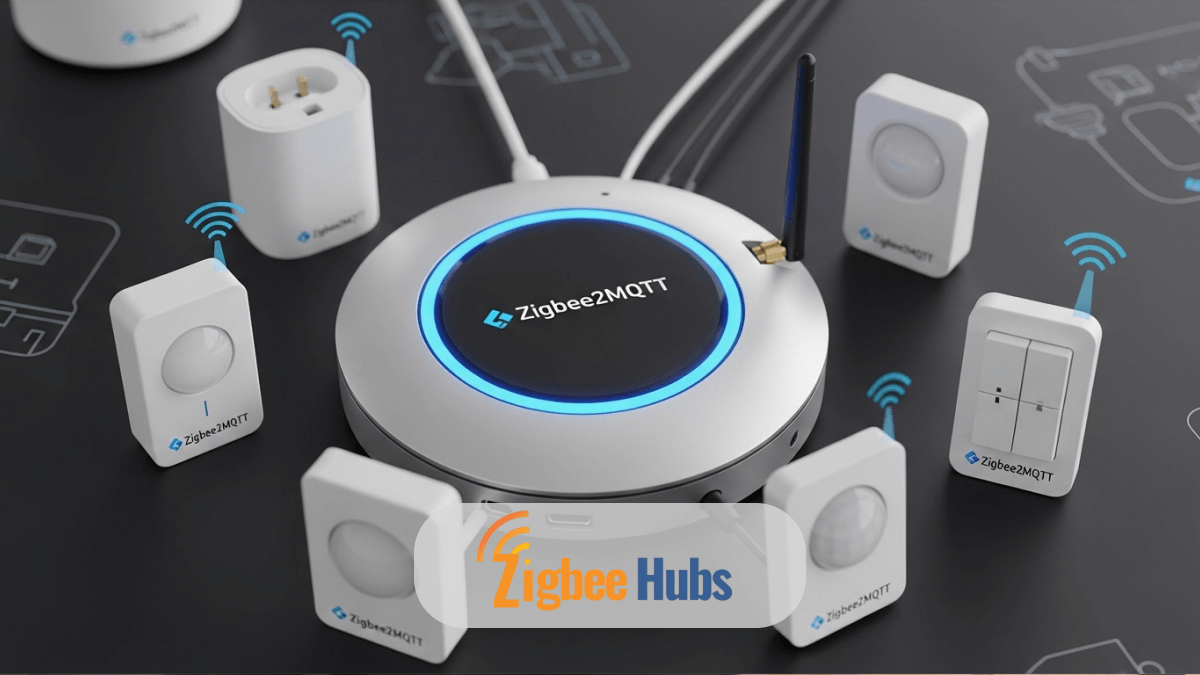
- Zigbee Coordinator (The Hub/Gateway): This device is the brain or administrator of the network. The Coordinator establishes the network, manages routing tables, and serves as the Trust Center responsible for managing and distributing security keys. It must be powered constantly.
- Zigbee Router: Routers are always-on, plugged-in Zigbee devices (such as smart plugs or light switches) that pass messages, extend the zigbee range, and allow new devices to join the network.
- Zigbee End Device: These are typically battery-powered sensors or switches that react to commands. They can only send or receive information and cannot route messages for others, which allows them to save power by sleeping most of the time.
Platforms like Home Assistant Zigbee can use a dedicated Coordinator device to manage and control these sensors and switches.
Security
For protecting home data, Zigbee incorporates robust security features. It utilizes 128-bit AES symmetric encryption to protect data transmissions, which is the same level of security utilized by many banking systems. The system uses a Network Key (shared by all devices) and Link Keys (for device-to-device encryption), with the Coordinator often acting as the Trust Center that securely manages these keys.